Thorny Devil Baby Horned Lizard Vs Thorny Devil
A Desert Lizard That Drinks From Sand
The thorny devil stays hydrated thanks to its peel, which pulls water away from moist grains, confronting gravity and into its oral cavity.
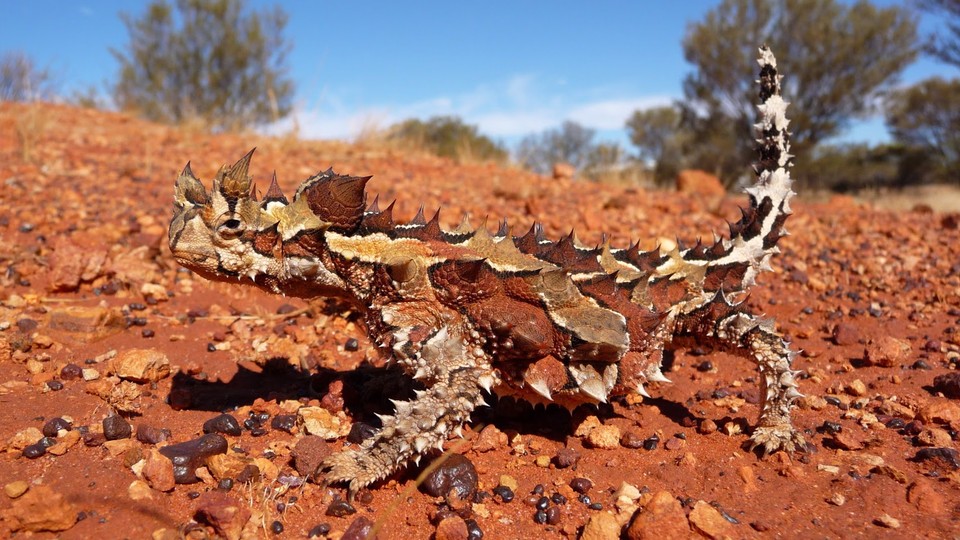
It's early morning time in the Australian desert, and a squat, palm-sized cadger chosen the thorny devil is having a potable. It hasn't rained for weeks, and there's no water in sight. The lizard's body is however and its head is raised. And yet, through nearly no try, it is quenching its thirst.
Its clandestine lies in its extraordinary skin. Between the intimidating and ostentatious spikes, there's a subtle network of microscopic grooves. These tin can yank water out of moist sand, drawing the fluid upward against the pull of gravity, across the cadger'due south body, and into its waiting mouth. All it needs to practise is to stand up in the correct spot and without flexing a muscle, it can drinkable with its skin.
Though long known to Aboriginal Australians, the lizard was first described by Western zoologists in 1841. Its fearsome advent earned information technology sinister names—the thorny devil, or Moloch horridus. In truth, the creature eats simply ants, and otherwise moves slowly and placidly. "They're like Swiss people—very relaxed," says Philippe Comanns, from RWTH Aachen University.
In 1923, one biologist wrote that the thorny devil "has the power of absorbing water through the skin afterward showers of rain." But that didn't make sense—a desert reptile with permeable skin would quickly dry out. In 1962, Two herpetologists discovered what really happens by putting i on the creatures in belly-deep h2o. They noticed "an advancing h2o forepart" moving over its skin and towards its mouth, which it opened and closed.
The liquid was clearly traveling through a phenomenon chosen capillary activity, where water can menses unassisted through narrow tubes, propelled past the natural attraction that water molecules have to the surface of that tube and to each other. That phenomenon drives water upward the stems and trunks of plants, into sponges and paper towels, through the nibs of fountain pens, and patently across the skin of the thorny devil. Essentially, the lizard'due south body is like a paper towel wrapped around a safe tube—a highly absorbent layer stretched over a totally impermeable one.
But where does the water come up from? Rain, puddles, and fog are deficient and fleeting in the outback. Some researchers suggested that the thorny devil licks dew from rocks and plants, just it doesn't really have the mechanics do that; its jaws and tongue are specialized for grabbing ants. Others suggested that its spines, like those of a cactus, might provide points for water to condense on its own trunk, but at that place'south no evidence that this actually happens.
In 1993, Philip Withers suggested a somewhat counterintuitive idea—maybe the lizard stands on moist sand. In the early morning, when dew condenses and falls to the ground, the sand becomes a petty clammy. It doesn't last for long, but it provides a temporary daily oasis for a thorny devil. Two decades later, Comanns has checked to see if this actually works.
By placing thorny devils in shallow puddles, he showed that their skin can agree upwards to iii.2 pct of their body weight in water—the equivalent of an average American developed carrying five pints. If the lizard drinks continuously, information technology tin can fully satisfy its thirst in under an hour. While it can indeed blot water from the moist sand, the grains really don't provide enough water—only upwards to threescore percent of its total chapters.
Yet thorny devils have a way of making their skins even more than absorbent than usual. In the wild, across but standing in sand, they have been known to rub their bellies into it and to flick it onto their backs. This pull a fast one on loads their channels with modest traces of water. And since water attracts water, already-wet surface will draw in more h2o than totally dry one.
Comanns confirmed this by making resin casts of the thorny devil's skin. If he outset placed moist sand on the casts, and then brushed information technology off, he establish that new droplets were more than likely to exist pulled into the grooves, rather than but beading on the surface. "Once yous fill up the channels, h2o immediately spreads on the skin," says Comanns.
"This provides excellent support for the hypothesis that sand-shoveling beliefs plays a function in the water-harvesting process," says Lisa Take a chance, from Montclair State University. The fob might help to pre-wet the skin, or it might give the lizards enough water in itself.
Either way, "it is exciting to observe new means past which animals cope with what we run into as 'harsh' environments," says Dale DeNardo, from Arizona State University. Many reptiles, he adds, use their skin to collect water. Rattlesnakes volition coil tightly in light rain, and then drinkable the water that collects between their coils. Horned lizards and thorny devils go ane pace further by using grooved peel. "The value of this is that pelting and any resulting puddles do not terminal long in the desert," DeNardo adds. "Being able to become drinking h2o from moist sand increases the opportunities for thorny devils to drink."
Source: https://www.theatlantic.com/science/archive/2016/11/this-lizard-can-drink-by-standing-still-in-sand/506288/
0 Response to "Thorny Devil Baby Horned Lizard Vs Thorny Devil"
Post a Comment