When Is It Safe to Fly Again
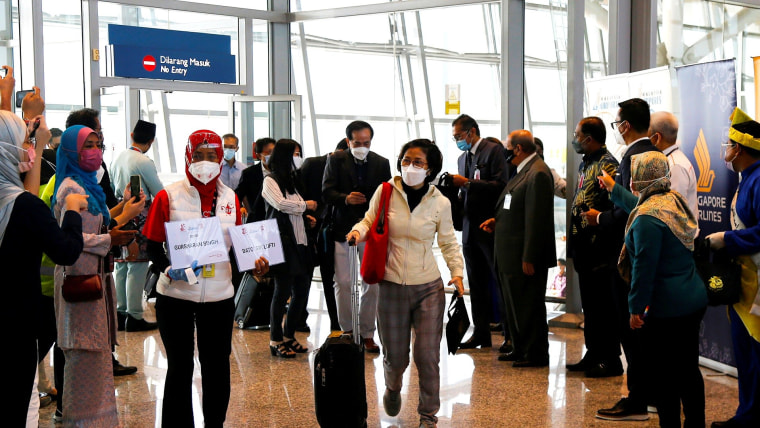
Airports are preparing for a trounce of passengers as holiday air travel in 2021 is expected to approach pre-pandemic levels.
More than 6 1000000 people are expected to fly between Dec. 23 and Jan. ii., with airlines projected to see a 184% increment in passengers from 2020, according to AAA, which called it a "dramatic bounciness-back."
"With vaccines widely available, weather condition are much dissimilar and many people experience a greater level of comfort with travel," said Paula Twidale, senior vice president of AAA Travel, in a statement.
Holiday bookings for Christmas and the New Year's holiday have been coming in "very, very strong," Ed Bastian, the CEO of Delta Air Lines, told CNBC. United has been flying its largest schedule since the start of the pandemic, adding more 200 daily domestic flights to meet the increased demand.
More than 2 million people passed through Transportation Security Administration checkpoints on Dec. 16, 2021 — more than double the passenger volume on the aforementioned day in 2020.
Just the rapid spread of the omicron variant may have many people wondering: Is it safe to fly right now?
'Very low' risk
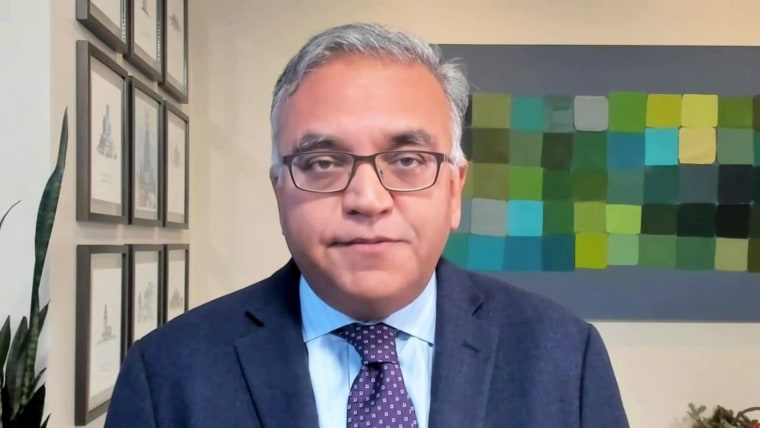
There's not a one-size-fits-all answer to that question — information technology all depends on a person's chance tolerance and their own gamble factors for severe disease, said Dr. Amesh Adalja, a senior scholar at the Johns Hopkins University Centre for Health Security in Baltimore and a spokesman for the Infectious Diseases Social club of America.
Masks are required on planes and at airports, and as long every bit people are complying, in that location'due south non a major risk from flying, he noted.
"Transmission on a aeroplane of COVID-19 is not very common because of the (air) apportionment and because of the mask wearing," Adalja told TODAY.
"(But) at that place'due south ever going to be some level of COVID take chances with any activity you practice, whether it's flying, riding the bus or going to the post office... for almost people, I think information technology'southward an acceptable take chances."
The more vaccinated passengers and crew are on a plane, the safer air travel is, Adalja added, so he was a fan of airlines mandating vaccinations as a condition of employment, the way United Airlines has.
Masking and vaccines are the best tools nosotros take against both the omicron and delta variants, he said.
The Centers for Illness Command and Prevention urged people to delay travel until they were fully vaccinated. If that's non possible, they should get tested one to 3 days earlier their trip.
Given the high quality of cabin air and the various safety measures in identify, in that location is "very low" hazard of contracting COVID-19 on board a airplane, according to the International Air Send Association, which represents airlines around the world.
What studies have found:
United Airlines and the Section of Defense teamed up on a six-month study that plant the run a risk of contracting COVID-19 on commercial flights was low when passengers wore masks for the entirety of the flying. The highest chance was associated with sitting in the aforementioned row, or a row in front of or behind, an infected person. This study didn't accept into account the risk associated with existence in a crowded drome or boarding a flying.
Researchers take said factors that may forbid transmission on planes include the airflow in the cabin from the ceiling to the floor and all passengers wearing face coverings.
But if everyone took off their masks at the same fourth dimension for a ane-hour in-flight meal service, the boilerplate infection probability increased past 59%, a written report published in the Journal of Travel Medicine in May 2021 establish.
Still, almost viruses don't spread hands on flights considering of how air circulates and is filtered on planes, the CDC noted.
Carriers like American Airlines take been touting the apply of high-efficiency particulate air (HEPA) filters on board that capture "at least 99.97% of airborne microbes by circulating the cabin air in one case every 2 to four minutes."
Airlines have likewise implemented enhanced cleanings and traveler health acknowledgments during bank check-in.
A newspaper past Arnold Barnett, a statistics professor at the MIT Sloan School of Management in Cambridge, Massachusetts, looked at the probability of an air traveler contracting COVID-19 from a nearby passenger while sitting in economic system course on a two-hour domestic U.Southward. flight. He assumed everyone was wearing masks.
Barnett calculated the risk at one in iv,300 for total flights, which went down to ane in 7,700 when centre seats were kept empty.
It's not clear that two hours spent on a airplane involved a higher COVID-19 infection hazard than two hours doing any other everyday activities during the pandemic, Barnett concluded in the report.
"Y'all don't get sick on airplanes any more than anywhere else," wrote Joseph Allen, an banana professor of exposure assessment science at Harvard T.H. Chan School of Public Health in Boston, in The Washington Mail. "The required aircraft systems do a really good job of controlling airborne bacteria and viruses."
Danger on the ground
Experts have been more than worried about coronavirus spread before flights.
"My concern has really been in the airports funneling people through hallways and jet ways and metal detectors," said Dr. Michael Mina, an epidemiologist at Harvard T. H. Chan School of Public Health, during a briefing in 2020. "The whole process of airports… and squishing people together. We know that this virus can be airborne and it tin can linger for a little chip."
Any part of the trip where you can't social distance is more risky since the virus transmits most efficiently when people are in close contact together, including at the airdrome food court and standing at the gate before boarding, Adalja added. He too believed people's behavior at the destination was usually riskier than the journeying itself.
If you plan to fly soon, Adalja recommended taking all the usual precautions during the trip: Launder your easily oftentimes, article of clothing a face covering as required, avoid the crowded parts of the airport and try to stay 6 anxiety apart from everybody. Always have hand sanitizer with yous.
Some studies take found the window seat may be all-time to avoid getting sick because it offers the least contact with other passengers, but Adalja was skeptical. It all depends on who's sitting abreast you lot since it's unremarkably 10-fifteen minutes of shut proximity — not fleeting contact — that transmits the new coronavirus virus, he said.
If y'all're more probable to get the severe grade of COVID-xix, consider if it's worth the adventure to wing. Don't wing if you lot're sick or take been in contact with someone who is ill. These are all important things to proceed in heed during the holiday travel flavor.
This article was updated in December 2021 to include the nearly recent research and statistics.
Source: https://www.today.com/health/it-safe-fly-during-covid-19-how-avoid-getting-sick-t190649
0 Response to "When Is It Safe to Fly Again"
Post a Comment