How Did the Art and Literature of the Depression
Culture and Arts during the Low
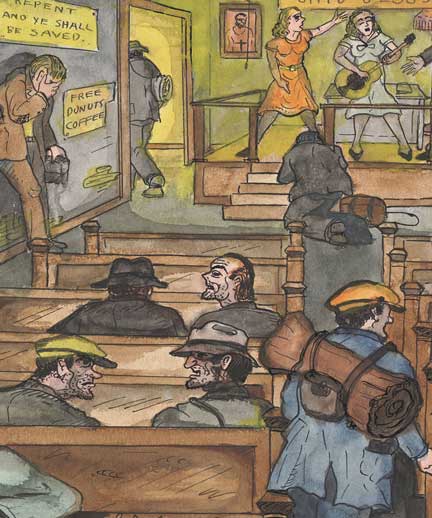
The Depression led not only to new arts funding, but a radical rethinking of how to express the social experience of the Depression itself. "Mission House, Skid Road, Seattle, Wash. 1930," watercolor past Ronald Ginther. (Property of Washington State Historical Guild, all rights reserved.)
The 1930s were a period of intense artistic experimentation, as new forms and methods were explored, transformative cultural institutions were founded, and artists self-consciously sought to accomplish broader layers of the public. The ascent of social unrest during the Depression heightened the political concerns of artistic works, while New Bargain programs gave artists both federal recognition and the funding and space to piece of work out new cultural forms. Technical changes, like the popularization of the radio, inverse how attainable culture was and to whom, and an international break from formalism and modernism also worked to produce a popularized, socially conscious trend in American fine art. During the Low decade, Washington State, often seen equally marginal to national art history, hosted some of the nigh innovative theatre, musical, and performing arts work in the nation, with sometimes global resonance.
It is ane of the ironies of the Great Depression that the emblematic cultural establishment of Washington Country, the Seattle Art Museum, was created and privately funded during the darkest days of the economic crisis, when tens of thousands were losing jobs and homes. SAM was a gift to the metropolis from art collector Richard Fuller and his wealthy mother Margaret Fuller. In 1931, they hired UW builder Richard Gould to design a museum sited in Volunteer Park and pledged much of their personal art drove to the city. The building, which now houses the Seattle Asian Art Museum, opened to the public in 1933.
The SAM story reminds u.s.a. that not everyone suffered or even lost money during the Depression and reminds us too that philanthropy accelerated in the 1930s, as some of those who retained wealth gave to charities to aid the unfortunate and others gave to the arts to rescue cultural institutions that struggled among the economic refuse.
But more than important than philanthropy was the new role that government funds and government programs would play after 1933. For the first time in American history, art was deemed worthy of public support, and New Deal federal dollars enabled an explosion of creative endeavors, from painting to music to theatre to architecture. The 1930s would prove to be a pivotal decade for Washington State's arts and culture, leaving the region with new institutions, lasting artistic accomplishments, and a new public understanding that art was no longer just for the wealthy.
Cornish College
Washington's cultural ferment of the 1930s and the New Deal era would not have been possible without the existence, decades earlier, of smaller institutions and artists collectives, most notably the pocket-size and struggling private Cornish College of the Arts, in Seattle. Founded every bit a music schoolhouse in 1914 by Nellie Cornish, the Cornish College of the Arts in Seattle grew to comprehend all the performing and visual arts, and served as the heart of the Northwest's growing fine art scene. Despite its financial and social ties to the more traditional Seattle Fine Arts Order, and the sometimes-conservative leanings of its Board of Directors, Cornish besides hosted performing artists who were breaking from traditional forms and experimenting with new modes of performance, presentation, and mode.
From a glance at the list of faculty and students during the 1930s, it is clear that Cornish was a seedbed for both regional besides as national cultural transformations during the Depression years: mod dancer Martha Graham taught at Cornish in the summertime if 1930 and was commissioned to give a solo Seattle functioning; innovative composer John Cage taught at the schoolhouse and adult his "prepared piano" at that place in 1938; Seattle native Merce Cunningham began his trip the light fantastic toe preparation at Cornish in 1937-1939, and was discovered in that location by Martha Graham, who promoted his career in New York; and hosted Northwest native and modernist photographer Imogen Cunningham as an artist-in-residence in the late 1920s; and Florence and Burton James began their theatre experiments as faculty at Cornish earlier founding the Seattle Repertory Playhouse. [ane] The "Northwest Schoolhouse" of painters—Morris Graves, Mark Tobey, Guy Anderson, and Kenneth and Margaret Callahan—based at Cornish and in the rural Skagit Valley, sought out a new aesthetic that combined natural forms with the influences of Asian art, and added some other dimension to the innovations of 1930s and 1940s culture.
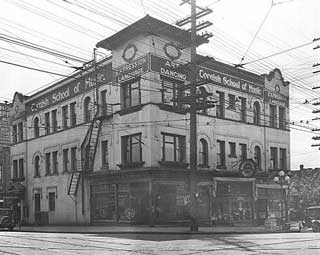
Cornish Schoolhouse of Music in 1920, downtown on Broadway and Pine, before relocating to Roy St. on Capitol Hill. Nellie Cornish founded the school in 1914, and it functioned equally a eye of new arts movements in Seattle. (Photo courtesy of the Museum of History and Manufacture)
With the market crash of 1929, the drastically contracted market for the arts and lack of money for patronage may have prompted some of the independence and radical revisions of artistic forms and new visions of what music, images, and movement could be. Every bit Kenneth Callahan, a member of the loose Northwest Schoolhouse and assistant director of the Seattle Art Museum wrote in 1936, "Since 1929 artists, for the greater role, have come to the realization that at that place is no longer a marketplace for their output. Whereas formerly artists attempted to see, interpret and execute their piece of work and style that conformed to the tastes of the moment, many thereby making a fair living, today the situation is very different… [T]hither is trivial actual buying of the art of contemporary artists. As a result, more than and more painters are devoting themselves to problems of painting, crafts, and interpretation." [ii]
New Bargain Arts Funding
Equally office of the public relief programs of the New Deal, artists, musicians, actors, and writers were employed by the federal government in an array of projects designed to create jobs. These programs started in a minor fashion in 1933 and so became more common afterwards 1935. Piece of work relief was ane of the goals, just leaders of these programs often likewise hoped to sponsor indigenous, regional talent and encourage the growth of a national, popular creative culture. The guiding philosophies of the Federal Fine art, Federal Theatre, Federal Writers', and Federal Music Projects (all 1935–1939) promoted publicly engaged and publicly accessible arts. New ideas about the social responsibilities of artists and new styles and subject matter—conveyed past the artistic characterization "social realism"—were part of this artful transformation.
The artistic legacy of the New Deal tin can be seen today in the murals that adorn public buildings throughout the land, including schools, libraries, and mail offices. Hundreds of artists worked on these murals, which in the spirit of the time, were usually painted in a realistic style and depicted groups of men and women working together in common crusade, either in 1930s contemporary scenes or in re-visions of the past history. See Visual Arts in the Great Depression, a special department of this website.
The painters of what became known as the Northwest Schoolhouse worked in a different aesthetic, often interested more in nature than people, exploring the light and color of the Puget Sound with tones and techniques strongly influenced by Japanese creative person traditions. They would give the region its first widely recognized creative motility—modest in the scheme of American art history—but an of import contribution to regional pride and along with Cornish (where several taught) a factor that would, in the future, attract artistic talent to the region.
William Cumming may be the virtually significant of the new artists of the Great Low. A protégé of the Northwest School, he veered dorsum and forth betwixt modernism and social realism, committed to what biographer Matthew Kangas calls "the image of consequence, that is, subjects that ordinary people could chronicle to in their own lives, images that could resonate without the taint of moralizing propaganda." [3]
Propaganda was precisely the purpose of two other artists who have left the states riveting images of street life and political activism of the 1930s. Woodcut artist Richard Correll began illustrating the Seattle Communist Party's paper, the Vox of Action, producing a new creative mode and political statement with broad appeal. Indeed, Correll'south work became then popular that he began teaching woodcutting classes. Dark, powerful, and complex, his remarkable graphics tell stories of strikes and struggles for economic and social justice. [four]
Ronald Ginther painted in obscurity throughout the 1930s. A self-taught artist who worked with ink and watercolors, his collection of more than than fourscore vividly colored scenes are a unique resource, depicting the rough life of Hoovervilles and homeless men, of jails and soup kitchens, unemployed demonstrations and police force attacks, strikes and radical protests—all of which he knew well.
Theatre, Photography, Music, Film
As discussed in Theatre Arts in the Slap-up Depression, a special section of this website, Washington's sectionalisation of the Federal Theatre Project was one of the nation'due south most successful and all-encompassing programs that drew on onetime Northwest theatre traditions like vaudeville as well as Depression-era civil rights concerns to shape its programs. Washington Land's Federal Theatre Project included a traveling vaudeville company, the all-African American Negro Repertory Company, a Children's Theatre, and produced "Living Newspapers" that dramatized regional current events.
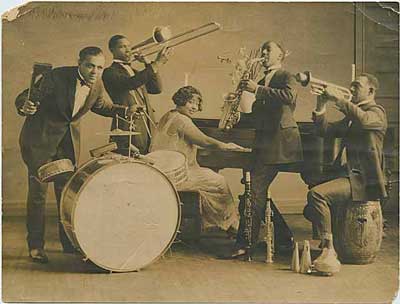
Seattle's jazz culture flourished in the 1920s and 1930s, particularly in the multiracial neighborhood culture of Jackson Street in Seattle'due south Cardinal District. Pictured here is Edythe Turnham and her Knights of Syncopation, c. 1925. Turnham toured the Northwest with her band and played upwardly and down the Westward Coast and on President Line Cruises, embodying travel routes that linked Washington musicians to the rest of the nation and the state. (Epitome courtesy of the University of Washington Library Digital Collections.)
Washington'due south Low was likewise the subject area for two famous American artists who lent their talents to promote federal projects, mingling their own social and artistic concerns—sometimes uneasily, sometimes happily—with the needs of the New Deal government. Dorothea Lange, whose photographs of California'due south Depression migrants have get iconic images of the Depression, photographed migrant farm laborers in Washington'southward Yakima Valley in 1939—as well as the later Japanese American internment camps—for the Farm Securities Administration. Folksinger Woody Guthrie was commissioned to write songs promoting public utilities and work relief-built dams on the Columbia River, producing 1941's "Roll on, Columbia," the current state song.
The Low years likewise saw Washington'south emergence in national films, as the major Hollywood studios gear up and filmed many major 1930s films in the State's mountains and waterfronts. Washington'southward mountains served every bit cheaper stand-ins for the Alaskan Yukon, while scenes of Seattle'due south waterfront provided authenticity and novelty to Hollywood's films. Country boosters used the films equally ways to bring tourism to the Land, while Hollywood sometimes employed Washington'south unemployed equally temporary film crews.
Symphonic music suffered during the Great Depression. Seattle had an undistinguished, mostly volunteer symphony at the offset of the decade and despite support from the Federal Music Projection, that institution and other local symphonies would struggle for audiences throughout the decade. Radio was office of the problem for the symphony, merely part of the popularization of art in the era: radio networks now delivered music of many kinds straight into the family living room at no price.
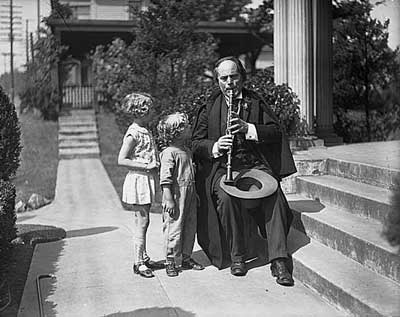
Greek clarinetist Nicholas Oeconamacos, who had performed under John Philip Sousa and the Seattle Symphony conductor Homer Hadley, returned to Seattle during the Great Depression to play for change on the street. Federal and regional funding also provided assistance for unemployed musicians, and the City Council sponsored outdoor concert serial in the parks as one way to employ musicians. (Seattle PI photograph, 1931, courtesy of the Museum of History and Manufacture)Bands playing popular music in clubs and dancehalls also struggled in the early 1930s, merely with the stop of prohibition in 1933, going to clubs became very popular for those who could beget it. As Jazz evolved into Swing Jazz, dancing became the rage. Jackson Street, the eye of Seattle'southward black community, was also the eye of the region'southward Jazz scene. Local bands played the Jackson Street clubs and attracted mixed blackness and white audiences, while touring large bands found larger venues downtown where only whites were immune.
Every bit it was in the rest of the state, the Depression-era arts in Washington Country both chronicled people'due south experiences and gave vocalisation to a detail vision, born of economical crisis, of social change and renewal. The combination of federal arts funding through the New Deal and the stimulation of social movements for civil rights, industrial unionism, and social reform created a new cultural environs, new forms of fine art, inverse understandings of community and individual social roles, and a collapse of distinctions between fine art, civilization, and politics.
Copyright (c) 2009, Jessie Kindig
Next: Visual Arts in the Great Depression
Click on the links below to read illustrated research reports on civilization and the arts during Washington's Depression.
 | Ronald Ginther Watercolors Ginther produced more than 80 paintings. They are a unique resource, depicting the rough life of Hoovervilles and homeless men, of jails and soup kitchens, unemployed demonstrations and police attacks, strikes and radical protests. |
 | The Ability of Fine art and the Fear of Labor: Seattle's Production of Waiting for Lefty in 1936, by Selena Voelker The Jameses founded the Seattle Repertory Playhouse and played a crucial office in the development of the Federal Theatre Project in the country, also every bit reimagining the role of theatre in Washington. |
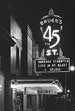 | Escape to the Movies: Seattle Cinema in the Great Low, by Andrea Kaufman Movie houses found a variety of means to bring people to the cinema during the Depression, from special deal nights and promotions to new escapistf moving-picture show genres. |
 | When Hollywood Went to Washington: Film's Gilded Age in the Evergreen State past Zachary Keeler Hollywood and Washington Country formed a mutually beneficial relationship during the 1930s, as Hollywood films brought tourism and job opportunities to Washington and used its settings to portray the Alaskan Yukon or to stand in for the rural W. |
 | Jazz on Jackson Street: The Nascence of a Multiracial Musical Community in Seattle, by Kaegan Faltys-Burr Seattle's jazz scene flourished in the 1920s and 1930s, particularly in the multiracial neighborhood culture of the Fundamental District and Jackson St. |
 | Dorothea Lange essay series: Social Documentary photography Dorothea Lange visited Washington's Yakima Valley in 1939 to chronicle rural farm life and migrant families during the Depression. • Part ane: Dorothea Lange's Social Vision: Photography and the Smashing Low, by Emily Yoshiwara• Role two: Dorothea Lange in the Yakima Valley: Rural Poverty and Photography, by Stephanie Whitney |
 | Dorothea Lange's Yakima Valley Photograph Gallery |
 | Richard Correll and the Woodcut Graphics of the Vocalism of Action, by Brian Grijalva Seattle's Communist Party newspaper relied on woodcut artist Richard Correll for many of its illustrations. Correll art was stark and unforgettable. He could narrate a strike or detail a militant political position in a single 4 inch by 5 inch paradigm. |
 | The 1932 Seattle Sports Scene: Helping the Emerald Metropolis through Hard Times, past Brian Harris Seattle rallied around its sports teams and prospective Olympic athletes as a symbol of community life and leisure during the Depression, despite loss of funds for many sports programs. |
 | The Rainy Metropolis on the "Wet Coast": The Failure of Prohibition in Seattle, by Kayta Katherine Samuels Prohibition failed to control the production, consumption, and enjoyment of booze in Seattle and the entire "wet coast." |
Visual Arts | |
 | Federal Art Project in Washington State The most ambitious of the New Deal visual arts programs, the Federal Art Projection emphasized work relief for artists as well as public educational activity and documentation of folk traditions. In Washington Land, it employed dozens of men and women in diverse pursuits such every bit easel painting, mural painting, sculpture, teaching, model making and more. |
 | Public Works of Art Project in Washington Country The showtime visual arts program launched during the Groovy Low, the Public Works of Art Project employed more than iii,000 artists nationwide including 50 in Washington State. Information technology established an of import precedent regarding federal government back up for the arts and served equally a model for afterward initiatives. |
 | Post Role Murals and Art for Federal Buildings: The Treasury Section of Painting and Sculpture in Washington Country Centrally managed past the Treasury Section in Washington, D.C. the Section commissioned thousands of murals, wood carvings and sculptures for public buildings, including postal service offices, courtroom houses and federal bureau headquarters in the capital. As a result of its presence in pocket-size and big communities, this program'south work is perhaps the best known of whatever New Deal visual arts initiative. |
 | New Deal Post Role Murals in Washington Land This google interactive map marks the location of the 18 Washington State post offices that housed fine art commissioned past the Section. Common motifs include agriculture, logging and western history, featuring images of both Euro-American settlers and Native peoples. For more than data on the Treasury programme, please meet the enquiry report "The Section of Painting and Sculpture in Washington State," |
 | The Spokane Art Center: Bringing Art to the People In addition to providing gainful employment to thousands of unemployed artists, the Federal Fine art Project (FAP) also stressed fine art education through community art centers as one of its primary objectives. One of the most successful sites, hosting lthousands of visitors and hundreds of classes, was located in Spokane, Washington. |
Theatre Arts | |
 | Federal Theatre Project in Washington State, by Sarah Guthu The FTP in Washington was one of the most vibrant in the country, including the Negro Repertory Unit of measurement, Living Paper theatre journalism, a Children's Unit, and hosted traveling productions to New Deal public works programs around the country. |
 | Seattle's Negro Repertory Company: Outside of New York City, Washington's FTP hosted the only all-African American company in the nation, who produced three plays: Stevedore, about a longshore strike; an all-black production of Lysistrata, which was closed down for its "scandalous" scenes; and a production written by the Negro Unit of measurement based on the life of poet Paul Laurence Dunbar. • Stevedore , past Sarah Guthu• Lysistrata, by Sarah Guthu • An Evening with Dunbar, by Sarah Guthu |
 | The Jameses and the Playhouse, by Sarah Guthu The Jameses founded the Seattle Repertory Playhouse and played a crucial function in the development of the Federal Theatre Projection in the state, as well equally reimagining the office of theatre in Washington. |
 | Living Newspapers: These productions combined theatre with journalism, and brought regional controversies to life, including battles over public and private ability; the regulation of syphilis; and immigration. • Power, by Sarah Guthu• Spirochete, past Sarah Guthu • One Third of a Nation, by Sarah Guthu |
Notes
[1] Richard C. Berner, Seattle, 1921–1940: From Boom to Bust (Seattle: Charles Press, 1992), 247–251; Cornish College of the Arts, "Making History," <http://world wide web.cornish.edu/nearly/history/>.
[2] Callahan's review quoted in Berner, Seattle, 1921–1940, 248.
[3] Matthew Kangas, William Cumming: The Image of Consequence (Seattle: Charles and Emma Frye Fine art Museum, 2005), p. 15.
[four] Brian Grijalva, "Richard Correll and the Woodcut Graphics of Phonation of Action," Communism in Washington State History and Memory Project, <http://depts.washington.edu/labhist/cpproject/correll.shtml>.
Source: https://depts.washington.edu/depress/culture_arts.shtml
0 Response to "How Did the Art and Literature of the Depression"
Post a Comment